
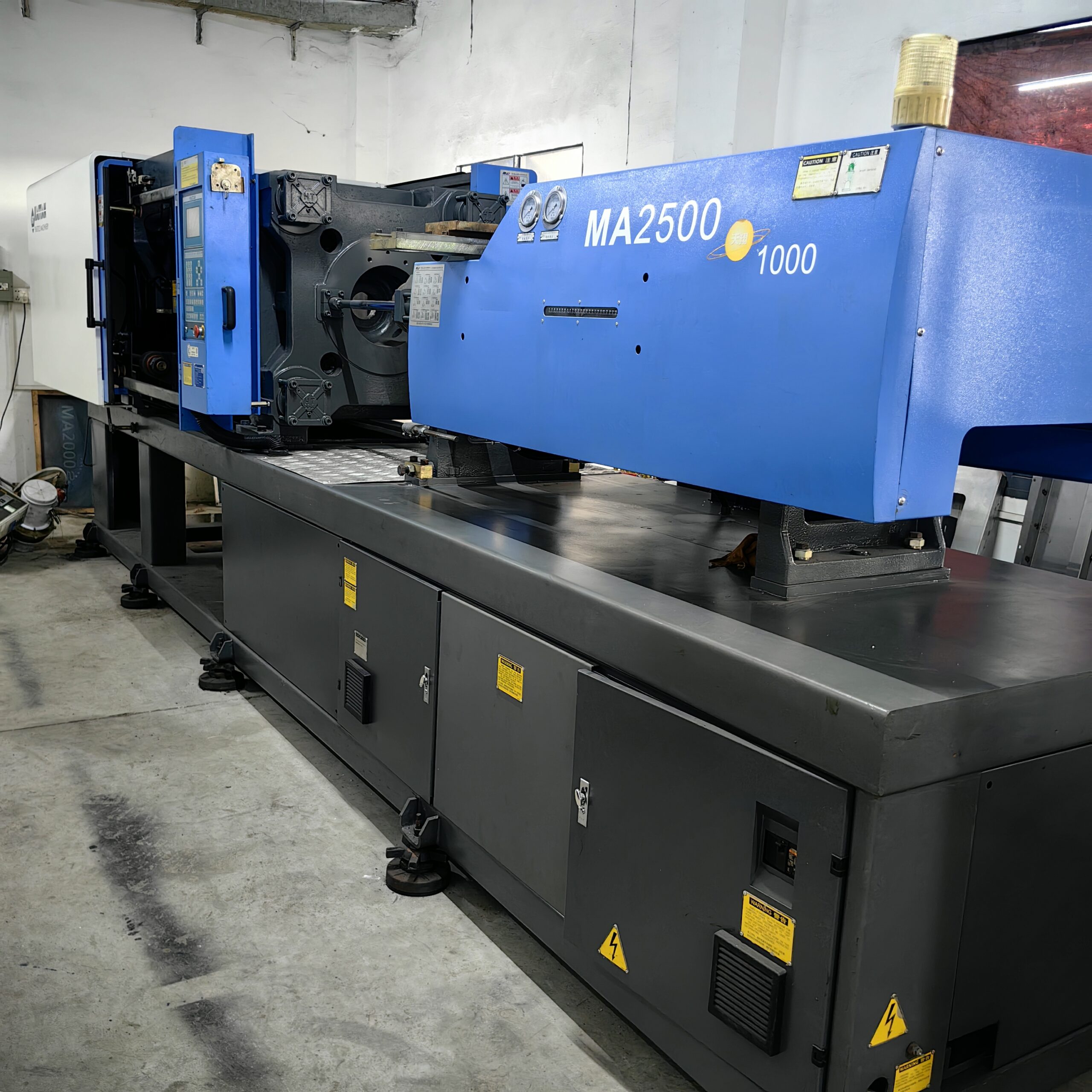
Choosing a used industrial injection molding machine requires more than comparing clamping force, purchase price, or machine age. The machine must match the plastic material, required shot size, processing temperature, mold dimensions, and production conditions.
A machine that works well with polypropylene may not be the best choice for engineering plastics or glass-fiber-reinforced materials. Likewise, a machine with sufficient clamping force may still be unsuitable if its injection capacity, screw design, temperature control, or mold installation dimensions do not meet production requirements.
For manufacturers sourcing used injection molding equipment, the goal is to find a machine that can process the intended material consistently without unnecessary energy consumption, excessive wear, or avoidable quality problems.
This guide explains how to evaluate material compatibility, injection capacity, temperature requirements, mold specifications, and equipment condition before purchasing a used industrial injection molding machine.
1. Start with the Plastic Material You Plan to Process
The plastic material should be one of the first factors in machine selection. Different resins have different melting behavior, viscosity, moisture sensitivity, processing windows, and effects on machine components.
Before evaluating a used injection molding machine, identify the exact resin grade and obtain its technical data sheet and recommended processing conditions.
Common Plastics and Their Processing Requirements
| Plastic Material | Typical Applications | Key Machine Selection Considerations |
|---|---|---|
| Polypropylene (PP) | Household products, containers, automotive components | Suitable screw configuration, stable melt temperature, and effective cooling |
| Polyethylene (PE) | Packaging components, containers, industrial parts | Material-specific temperature control, injection capacity, and cooling requirements |
| Acrylonitrile Butadiene Styrene (ABS) | Housings, consumer products, appliance components | Stable temperature control, appropriate screw design, and surface-quality consistency |
| Polycarbonate (PC) | Transparent components, electrical housings, protective parts | Higher-temperature capability, moisture control, and suitable injection performance |
| Polyamide (PA) | Gears, brackets, mechanical components | Drying requirements, material-specific temperature settings, and control of moisture-related defects |
| Glass-Fiber-Reinforced Plastics | Structural components, engineering parts | Screw and barrel wear resistance, appropriate screw design, and controlled plasticizing conditions |
| PVC | Pipes, fittings, profiles, and selected molded products | Material-specific processing controls and compatibility of the screw, barrel, seals, and other wetted components |
These are general selection considerations, not universal specifications. Actual processing conditions depend on the resin grade, additives, part geometry, and supplier recommendations.
Check Whether the Screw and Barrel Suit the Material
The screw and barrel directly affect plasticizing, mixing, melt quality, and material residence time.
When reviewing a used industrial injection molding machine, check:
- Screw diameter, compression ratio, and configuration
- Screw and barrel material or surface treatment
- Wear condition and measured clearances, where applicable
- Compatibility with abrasive or corrosive compounds
- Plasticizing capacity and recovery time
- Availability of replacement parts
Glass-fiber-reinforced plastics can accelerate wear on unsuitable screw and barrel surfaces. Certain PVC formulations require particular attention to material compatibility and thermal stability.
A machine that previously processed a similar resin may offer useful history, but previous use alone does not prove that the screw and barrel remain suitable. Inspect their current condition and compare the configuration with the target material.
Consider Moisture Sensitivity and Material Preparation
Some plastics, including many polyamide and polycarbonate grades, require drying before molding. Inadequate drying can contribute to defects, reduced mechanical performance, or inconsistent appearance.
The machine itself does not replace proper material preparation. Confirm whether the production line needs a hopper dryer, desiccant dryer, loader, dosing system, or other auxiliary equipment.
For used equipment, check whether the required auxiliaries are included, functional, and suitable for the material and expected production rate.
2. Match Injection Capacity to the Required Shot Size
A machine’s injection capacity determines how much plastic it can inject under specified conditions. Buyers should compare the machine’s rated shot capacity with the actual material requirement for the part and mold.
Selecting a machine with too little injection capacity may prevent the mold from filling reliably. Selecting a substantially oversized one can also create problems, including less favorable residence time or inefficient use of the plasticizing unit.
Calculate the Required Shot Weight
For a preliminary assessment, estimate the total shot weight from all cavities, runners, and other plastic volume injected during one cycle.
Total shot weight = part weight across all cavities + runner and sprue weight
For example, if a mold produces four parts weighing 35 g each and uses a runner system weighing 20 g per cycle:
- Total part weight: 4 × 35 g = 140 g
- Runner and sprue weight: 20 g
- Estimated total shot weight: 160 g
This calculation estimates the required shot mass. It does not, by itself, determine the correct machine.
Do Not Compare Shot Capacity Without Checking the Rating Basis
Injection capacity may be stated in grams of polystyrene, cubic centimeters, or another manufacturer-defined unit. A rating based on polystyrene cannot automatically be treated as the same mass capacity for every resin.
Actual usable shot capacity depends on the machine design, screw geometry, material density, and operating conditions.
When evaluating a used injection molding machine, confirm:
- The manufacturer’s stated injection capacity and the material used for the rating.
- The actual shot volume or mass required by the target mold.
- The machine’s usable injection stroke and plasticizing performance.
- Whether the intended shot size falls within a suitable operating range for that specific machine.
- Whether the machine can recover the required material volume within the planned cycle time.
As an initial screening approach, buyers often avoid operating a screw at extremely low or near-maximum utilization. However, the appropriate shot-size range is model- and material-dependent. Confirm it with the machine manufacturer or a qualified process engineer rather than applying a universal percentage.
Evaluate Plasticizing Capacity as Well as Shot Size
Shot capacity describes how much material the machine can inject, but plasticizing capacity determines how quickly it can prepare the next shot.
A machine may have enough injection capacity yet struggle to melt and homogenize the required material within the target cycle time.
This matters when producing large parts, using engineering plastics, or operating at short cycle times. Check the manufacturer’s plasticizing-capacity data and verify actual recovery time during a production trial.
3. Match the Machine’s Temperature Capability to the Resin
Processing temperature is another critical factor when selecting a used industrial injection molding machine. The barrel, nozzle, and temperature-control system must support the resin’s recommended processing window.
However, the displayed temperature range alone does not guarantee stable melt conditions. Heating capacity, sensor accuracy, control performance, screw design, and material residence time also affect processing results.
Confirm the Required Melt and Barrel Temperature
Different resin grades may require substantially different processing temperatures. For example, a machine configured for common commodity plastics may need additional verification before processing a higher-temperature engineering resin.
Check the resin supplier’s technical data sheet for:
- Recommended melt temperature
- Barrel temperature profile
- Mold temperature requirements
- Maximum recommended residence time
- Drying temperature and time, where applicable
- Special requirements for additives or reinforced grades
Do not use one temperature setting for every grade within a polymer family. Different formulations can have different processing windows.
Inspect the Heating and Temperature-Control System
Before purchasing a used machine, inspect the condition and performance of its heating zones, thermocouples, controllers, and nozzle heater.
A practical inspection should confirm that:
- Each heating zone reaches its setpoint.
- Temperature readings remain stable under normal operating conditions.
- Fault alarms and temperature-control functions operate correctly.
- The nozzle and barrel configuration suit the intended material.
- The machine can maintain the required processing conditions during a representative production cycle.
For heat-sensitive materials, also review the screw’s plasticizing behavior and the time material remains inside the barrel. Excessive residence time or inappropriate processing conditions can degrade some resins even when the setpoint appears acceptable.
Consider Mold Temperature and Cooling Requirements
Mold temperature is different from barrel temperature. The mold may require a separate temperature-control unit or cooling circuit to achieve the desired part quality and cycle time.
Check whether the mold needs:
- Water cooling or a temperature-control unit
- Higher-temperature oil or water circulation
- Multiple independently controlled circuits
- Adequate flow and heat-removal capacity
- Compatible hose connections and fittings
The machine and its auxiliaries should be assessed as a complete production system, particularly when the target resin requires controlled mold temperatures.
4. Match Clamping Force and Mold Dimensions
Even when material, shot size, and temperature requirements are compatible, the machine must accommodate the mold and provide sufficient clamping force.
Calculate the Required Clamping Force
During injection, pressure inside the mold creates a force that tends to separate the mold halves. The machine’s clamping system must resist this force while maintaining stable mold closure.
A preliminary estimate can be expressed as:
Required clamping force depends on projected area × effective cavity pressure, with suitable engineering allowances.
The projected area includes the part and relevant runner areas projected onto the mold-opening direction. Effective cavity pressure depends on the material, part geometry, flow path, filling conditions, and process settings.
Do not select a machine using a generic clamping-force multiplier alone. The required force should be estimated from the actual mold and process, then checked against the machine manufacturer’s recommendations.
Too little clamping force can cause flash or mold separation. Excessive clamping force can increase mechanical loading and may contribute to mold or machine wear if applied inappropriately.
Verify the Mold Installation Dimensions
The machine’s nominal clamping force is only one part of mold compatibility.
| Machine Specification | Why It Matters |
|---|---|
| Tie-bar spacing | Determines whether the mold can fit between the tie bars |
| Platen dimensions | Defines the available mold mounting area |
| Minimum and maximum mold height | Determines whether the mold fits within the clamping system’s range |
| Maximum daylight | Limits the available opening distance |
| Mold opening stroke | Affects part removal and core-pull requirements |
| Ejector stroke and force | Must suit the mold’s ejection mechanism |
| Locating ring and nozzle interface | Must match the mold’s sprue-bushing arrangement |
| Hydraulic, electrical, and signal interfaces | Must support required core pulls, valves, and other mold functions |
A mold can fit on the platen yet remain unsuitable if its height, opening requirement, ejector configuration, or nozzle interface is incompatible.
Before committing to a used machine, compare the actual mold drawing and installation requirements against the machine’s technical documentation.
5. Check Injection Pressure, Speed, and Material Flow
Two machines with similar clamping force and shot capacity may behave differently when processing the same mold. Injection pressure, injection speed, screw design, and control performance can influence filling, packing, and part consistency.
Evaluate the Mold’s Filling Requirements
Thin-walled parts, long flow paths, and complex geometries may require higher injection speed or pressure than simple, thick-walled components.
The machine must deliver the necessary injection performance without exceeding its rated limits or compromising material quality.
When reviewing a used industrial injection molding machine, ask:
- What are the rated maximum injection pressure and injection speed?
- Can the machine maintain the required filling profile?
- Does the screw diameter suit the target shot volume and process?
- Can the machine provide stable packing and holding pressure?
- Are the injection-position and pressure controls functioning correctly?
Machine ratings should be interpreted according to the manufacturer’s definitions. For example, hydraulic system pressure and plastic injection pressure are not necessarily the same specification.
Verify the Condition of the Injection Unit
Wear or control problems can undermine the performance of an otherwise suitable machine.
Inspect the injection unit for:
- Unusual noise, vibration, or leakage
- Inconsistent screw recovery
- Abnormal variation in cushion or shot position
- Signs of screw or barrel wear
- Unstable injection pressure or speed
- Problems with the non-return valve, where fitted
These checks should be supplemented by a production trial using the target material and, ideally, the intended mold. A machine’s ability to complete a short demonstration cycle does not establish that it can maintain consistent quality throughout production.
6. A Used Injection Molding Machine Inspection Checklist
A machine that matches the material and mold on paper still needs a condition assessment. Used equipment may have different maintenance histories, operating hours, and levels of wear.
Mechanical and Hydraulic Systems
Check the clamping mechanism, tie bars, platens, hydraulic pump, valves, hoses, cylinders, and lubrication system as applicable. Look for leakage, abnormal noise, visible damage, and evidence of poor maintenance.
Electrical and Control Systems
Verify the CNC or machine controller, operator interface, safety interlocks, sensors, alarms, and temperature controllers. Confirm that essential functions work and that required spare parts or technical support are available.
Production Trial
Where practical, test the machine using the intended resin and mold, or a representative setup with comparable requirements.
Observe:
- Melt preparation and screw recovery
- Filling and packing stability
- Cycle-time consistency
- Part dimensions and surface quality
- Flash, short shots, sink marks, or other process defects
- Leakage, alarms, and abnormal operating behavior
The trial should use documented process settings and predefined acceptance criteria. If the actual mold is unavailable, record what was tested and which capabilities remain unverified.
Documents to Request
Ask for available model and serial-number information, technical specifications, maintenance records, service history, and the operating manual. Confirm the condition of included auxiliaries and clarify what is covered by the sale agreement.
For imported or relocated equipment, also verify electrical supply compatibility, safety requirements, installation needs, and any applicable local compliance obligations.
7. How to Choose the Right Used Industrial Injection Molding Machine
A reliable selection process starts with the production requirement and works backward to the equipment specification.
Step 1: Define the Product and Resin
Record the exact material grade, additives, part weight, cavity count, runner weight, and quality requirements. Include any drying or special handling requirements.
Step 2: Calculate Shot Size and Cycle-Time Needs
Estimate the total shot requirement and identify the target cycle time. Check both injection capacity and plasticizing capacity.
Step 3: Verify Temperature and Screw Compatibility
Compare the resin’s processing window with the machine’s heating, temperature-control, and screw-barrel specifications. Pay special attention to abrasive, corrosive, and heat-sensitive materials.
Step 4: Match the Mold and Clamping System
Confirm the required clamping force, tie-bar spacing, platen size, mold height, opening stroke, ejector specifications, and nozzle interface.
Step 5: Inspect and Test the Used Machine
Review maintenance history and machine condition. Arrange a representative trial when possible, and document any limitations or outstanding repairs.
Step 6: Compare Total Ownership Costs
Consider the purchase price alongside transportation, installation, auxiliary equipment, tooling, maintenance, energy consumption, and expected downtime.
The most economical machine is not necessarily the one with the lowest initial price. It is the one that meets production requirements at an acceptable total cost while maintaining the required part quality.
Frequently Asked Questions
1. Can one industrial injection molding machine process different plastic materials?
Yes, some machines can process multiple materials, provided their screw and barrel configuration, temperature range, injection capacity, and material-contact components are suitable. Material changes may also require purging, parameter adjustments, or auxiliary equipment.
2. How do I know whether a used injection molding machine has enough shot capacity?
Calculate the total shot weight or volume, including all cavities and the runner system. Compare this requirement with the manufacturer’s rated capacity using the correct rating basis, then verify that the intended shot size and recovery time are appropriate for the machine.
3. Is clamping force the most important specification?
No. Clamping force is important, but it does not establish overall suitability. Buyers must also consider shot capacity, plasticizing performance, processing temperature, mold dimensions, injection speed, and equipment condition.
4. Can a used injection molding machine process engineering plastics?
It can if the machine’s temperature capability, screw and barrel design, injection performance, and auxiliary equipment meet the resin’s requirements. Confirm the exact grade and conduct a suitable production trial before relying on the machine for critical applications.
5. What should I inspect before buying a used injection molding machine?
Inspect the clamping system, injection unit, screw and barrel, hydraulic or drive system, electrical controls, heaters, sensors, safety devices, and available maintenance records. A representative trial using the intended material and mold provides stronger evidence than a basic power-on demonstration.
Conclusion
Matching a used industrial injection molding machine to the correct plastic material requires a complete assessment of material behavior, shot size, processing temperature, injection performance, clamping force, and mold compatibility.
The best selection is not necessarily the machine with the highest tonnage or largest injection capacity. It is the machine whose specifications and actual condition meet the requirements of the intended resin, mold, part quality, and production cycle.
For buyers sourcing used equipment, a disciplined process—starting with the material data sheet, checking the complete mold setup, inspecting the machine, and validating performance through a suitable trial—helps reduce purchasing risk and avoid unnecessary operating costs.
Manyi can discuss your target plastic material, mold specifications, and production requirements to help you evaluate suitable used injection molding machine options. Contact Manyi to begin your equipment selection with a clearer technical checklist.



Add comment