
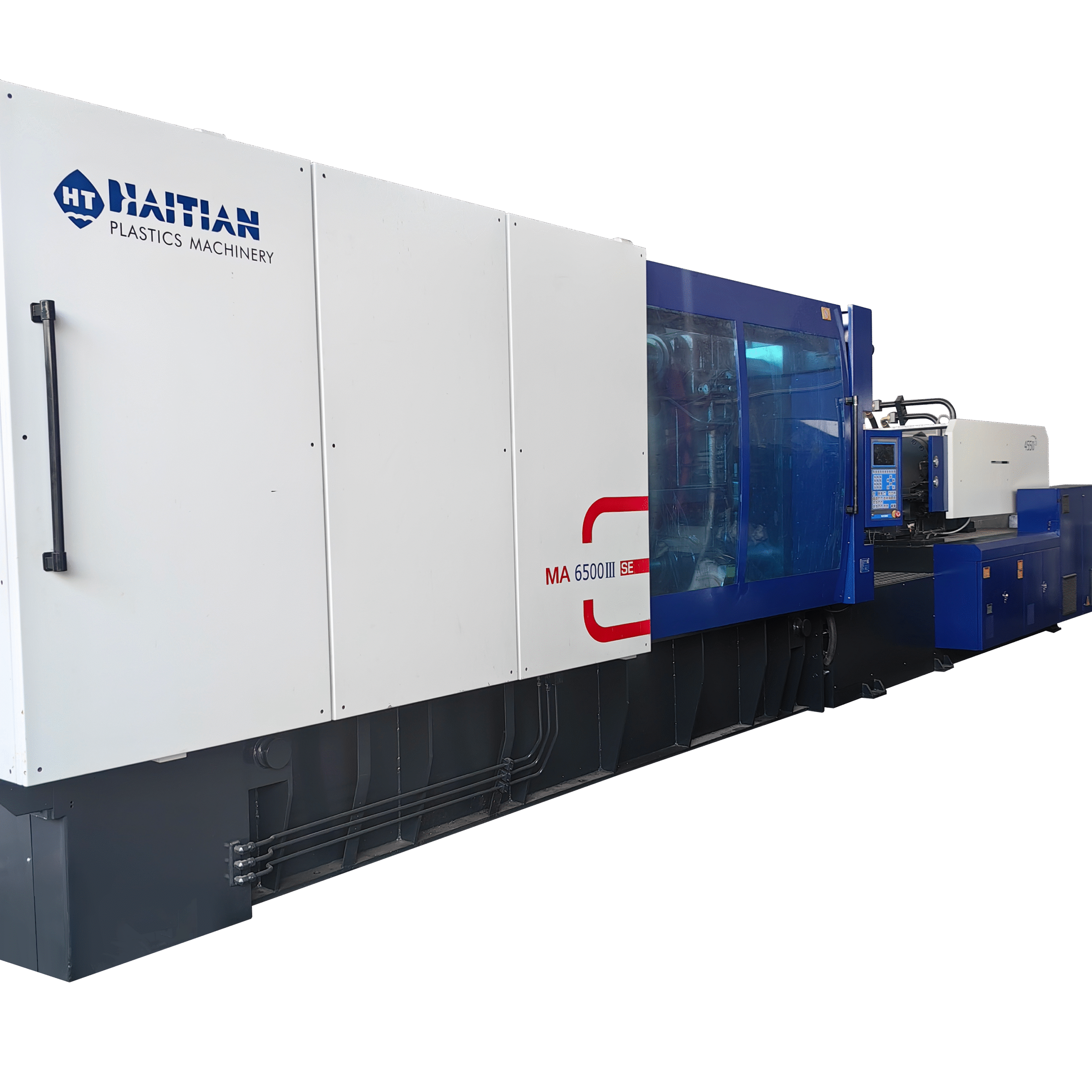
When purchasing a used 650-ton Haitian injection molding machine, factory owners and equipment buyers need to evaluate more than the machine’s age or purchase price. The actual condition of the clamping unit, servo system, control system, and hydraulic components directly affects molding quality, energy efficiency, and long-term reliability.
One of the most important checks is clamping force verification. The machine must generate sufficient force to keep the mold closed during injection while avoiding excessive mechanical stress.
For used equipment, a systematic inspection provides a more reliable assessment of machine value than simply comparing manufacturing years or model specifications.
1. Understanding Clamping Force in a 650-Ton Injection Molding Machine
Clamping force is the force generated by the clamping unit to keep the mold closed while molten plastic is injected into the cavity.
For a 650-ton injection molding machine, maintaining the correct clamping force is essential for stable production and consistent part quality.
Why Clamping Force Matters
Insufficient clamping force can cause several molding problems:
-
Flash caused by mold separation
-
Incomplete or inconsistent cavity filling
-
Dimensional variation
-
Material leakage around the mold parting line
-
Reduced overall product quality
On the other hand, excessive clamping force can place unnecessary stress on the mold and machine. It can also increase energy consumption and contribute to premature component wear.
Therefore, the objective is not simply to maximize clamping force. Instead, the machine should maintain the appropriate clamping force for the mold, material, and application.
What Determines the Required Clamping Force?
The required force depends on several production variables, including:
-
Part dimensions
-
Projected part area
-
Injection pressure
-
Plastic material
-
Mold design
-
Number of cavities
-
Processing conditions
For used equipment, buyers should verify that the machine can consistently achieve the required clamping force rather than relying only on the manufacturer’s original specifications.
2. Why Closed-Loop Control Matters in Used Haitian Machines
A closed-loop control system continuously monitors machine performance and adjusts operating parameters according to feedback from sensors.
This is particularly important when evaluating used injection molding equipment because control accuracy can deteriorate as sensors, valves, motors, and other components age.
How Closed-Loop Control Works
During the molding cycle, sensors monitor parameters such as:
-
Clamping force
-
Pressure
-
Temperature
-
Position
-
Injection conditions
The controller compares actual measurements with preset values. When a deviation occurs, the control system automatically adjusts the machine response.
This feedback process helps maintain stable operating conditions and improves repeatability from cycle to cycle.
Closed-Loop vs. Older Open-Loop Systems
Older hydraulic injection molding machines may use less sophisticated open-loop control systems. These systems provide less real-time feedback and can therefore experience greater variation in pressure, positioning, or clamping performance.
Newer Haitian machines with closed-loop control and servo technology provide more precise movement and faster responses.
For buyers evaluating used equipment, the presence and condition of these systems can therefore be more important than the machine’s production year alone.
3. Inspecting the Servo System on a Used 650-Ton Haitian Machine
The servo energy-saving system should be carefully inspected before purchasing a used 650-ton Haitian injection molding machine.
A complete inspection should cover the servomotor, feedback components, sensors, and control response.
1. Check Servomotor Operation
The servomotor should operate smoothly throughout the molding cycle.
Pay attention to:
-
Abnormal noise
-
Excessive vibration
-
Irregular acceleration
-
Unstable movement
-
Unexpected temperature increases
Unusual operating behavior may indicate wear or problems that could affect positioning accuracy and clamping performance.
2. Verify Encoder and Pressure Sensor Feedback
The rotary encoder provides positioning feedback to the control system, while the pressure sensor monitors pressure conditions.
During inspection, buyers should check:
-
Encoder feedback accuracy
-
Pressure sensor response
-
Calibration settings
-
Signal stability
-
Diagnostic results
Accurate feedback is essential because the controller relies on these signals to maintain the correct machine position and pressure.
3. Evaluate Closed-Loop Response
The complete servo control loop should also be tested.
The system should respond consistently when pressure or position settings change. Delayed or unstable responses may indicate problems with the controller, sensors, servo drive, or related components.
The machine’s control interface can also provide useful diagnostic information when evaluating system condition.
4. What to Check When Buying Used Injection Molding Equipment
When purchasing used equipment, buyers should evaluate the current operating condition rather than focusing only on the machine’s age.
A comprehensive inspection should include the following areas:
| Inspection Item | What to Check | Why It Matters |
|---|---|---|
| Clamping Force | Actual force stability and mold-locking performance | Prevents flash and filling problems |
| Servo Motor | Noise, vibration, temperature, and movement | Indicates servo system condition |
| Rotary Encoder | Feedback accuracy and signal stability | Ensures accurate positioning |
| Pressure Sensor | Calibration and pressure response | Supports precise closed-loop control |
| Control System | Response time and parameter stability | Maintains consistent molding cycles |
| Maintenance History | Service records and replaced components | Helps estimate remaining service life |
| Energy Consumption | Operating efficiency and servo performance | Affects long-term production costs |
| Cycle Time | Stability across repeated cycles | Indicates production consistency |
| Previous Usage | Application, workload, and operating environment | Reveals potential wear risks |
This approach gives buyers a more complete understanding of the machine’s actual value.
5. Why Servo Technology Matters for Used Haitian Injection Molding Machines
Servo technology is an important consideration when selecting used injection molding equipment.
Compared with conventional hydraulic systems, servo-driven systems can provide more precise movement control and improved energy efficiency.
For production facilities operating large machines such as a 650-ton Haitian injection molding machine, these advantages can contribute to:
-
More accurate machine positioning
-
Improved cycle consistency
-
Lower energy consumption
-
Faster response
-
Better overall production efficiency
However, buyers should not assume that every used servo machine will deliver the same performance as a new machine. The condition of the servomotor, drive, encoder, sensors, and control system must be verified individually.
6. Evaluate Machine Condition, Not Just Manufacturing Year
A common mistake when sourcing used injection molding machines is judging value primarily by production year.
A well-maintained older machine can sometimes provide better production performance than a newer machine with poor maintenance history.
Therefore, procurement teams should evaluate:
Maintenance History
Review available service records and identify major components that have been repaired or replaced.
Previous Production Conditions
Understand how the machine was used, including production volume, materials, mold sizes, and operating environment.
Component Upgrades
Check whether the machine has received servo upgrades, control-system improvements, replacement sensors, or other modernization work.
Actual Production Performance
Whenever possible, conduct a machine test under realistic operating conditions. Check clamping performance, cycle stability, energy consumption, and control response before finalizing the purchase.
7. Procurement Checklist for a Used 650-Ton Haitian Injection Molding Machine
Before purchasing used equipment, buyers can follow this basic evaluation process:
-
Verify the actual clamping force under operating conditions.
-
Inspect the servomotor for abnormal noise, vibration, or unstable movement.
-
Check encoder and pressure sensor feedback for accuracy and signal stability.
-
Test the closed-loop control response during pressure and position changes.
-
Review maintenance and replacement records for major components.
-
Evaluate cycle time and energy consumption during machine operation.
-
Check previous usage conditions and production workload.
-
Confirm available upgrades and replacement parts before purchase.
This process helps factory owners reduce the risk of purchasing equipment that appears cost-effective but requires significant additional investment after installation.
Technical Summary
When evaluating a used 650-ton Haitian injection molding machine, clamping force verification should be combined with a detailed inspection of the servo system and closed-loop controls.
Clamping force directly affects mold stability and product quality, while servo motors, encoders, pressure sensors, and feedback systems determine how accurately the machine maintains operating parameters.
For B2B buyers, the best purchasing strategy is therefore to evaluate actual machine condition, control performance, maintenance history, energy efficiency, and upgrade status, rather than relying solely on the equipment’s age.
A properly inspected used Haitian injection molding machine can provide reliable production capacity while reducing the initial investment required for large-scale injection molding operations.




Add comment