
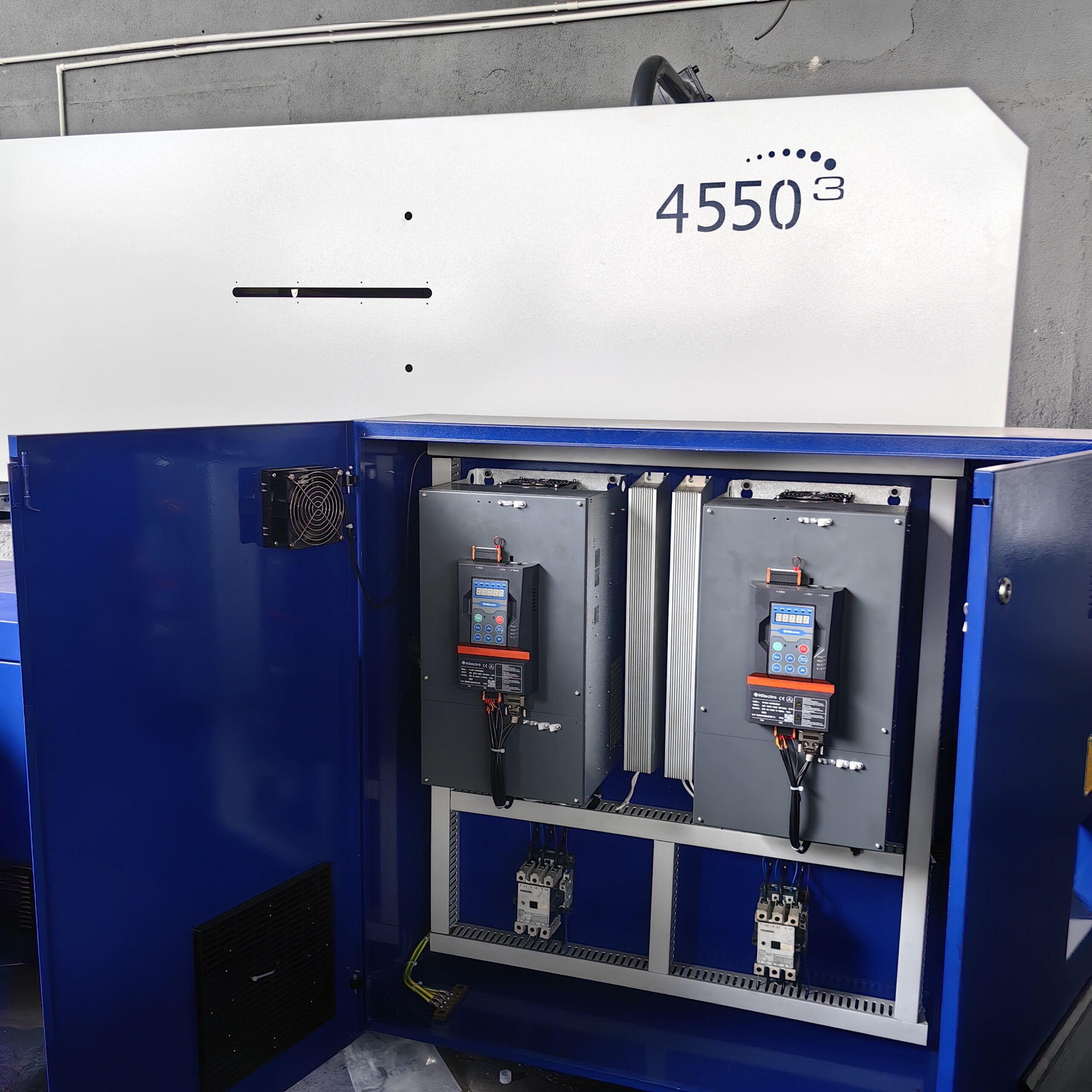
Selecting a used two-platen injection molding machine requires more than just looking at the price tag. The critical challenge lies in the physical compatibility between your mold dimensions and the machine’s technical specifications. If the tie-bar spacing is too narrow, the mold won’t fit; if the clamping force is insufficient, you face severe quality issues like flashing. Consequently, understanding the mechanical relationship between mold size and tonnage is essential for a high-performance custom plastic injection molding setup. This guide provides the formulas and lookup strategies needed to ensure your secondary market purchase is a perfect match for your production needs.
1. The Core Physics: Calculating Required Clamping Force
Before looking at used inventory, you must calculate the “Clamping Force” ($F$) required to keep your mold closed during the high-pressure injection phase. Using an insufficient tonnage leads to “flashing” and part deformation. Consequently, engineers use a standard formula to estimate the required force: F = A \times P
-
$A$ (Projected Area): The total surface area of the part (including the runner system) projected onto the mold parting line, measured in $cm^2$.
-
$P$ (Cavity Pressure): A constant based on material flow and part complexity, typically ranging from 0.3 to 0.5 t/cm^2.
Example: For a part with a projected area of 1000\ cm^2 using a pressure constant of 0.4\ t/cm^2, the required clamping force would be 400 Tons.
2. Tie-Bar Spacing: The “Physical Gateway.”
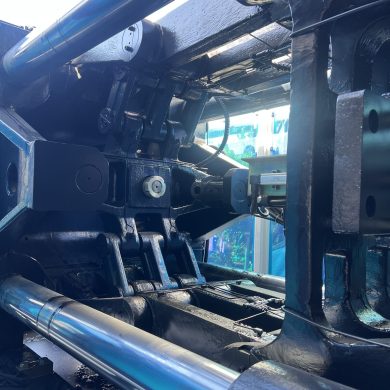
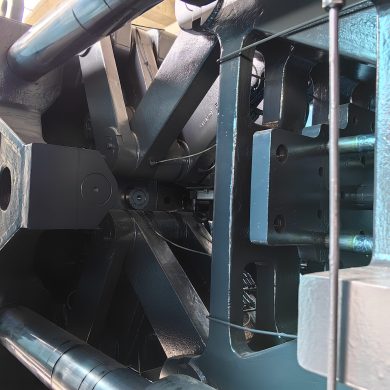
Even if the tonnage is correct, the mold must physically fit between the machine’s tie bars. In two-platen machines, the tie-bar spacing is the distance between the horizontal and vertical pillars that support the platens.
-
Horizontal vs. Vertical: Ensure your mold width and height are at least 50mm smaller than the tie-bar clearance to allow for safe installation.
-
Two-Platen Advantage: Two-platen machines typically offer a larger opening stroke and more generous tie-bar spacing relative to their footprint compared to traditional toggle machines.
Consequently, you can often fit larger molds into a smaller physical footprint. However, you must avoid the “Small Horse, Large Carriage” scenario, where a large mold is placed in a low-tonnage machine, leading to uneven pressure distribution and mold damage.
3. Mold Size & Tonnage Quick Reference Table
| Mold Projected Area (cm2) | Suggested Tonnage (Tons) | Typical Tie-Bar Spacing (mm) |
| 500 – 800 | 250 – 350 | 560 x 560 |
| 900 – 1500 | 450 – 600 | 820 x 820 |
| 1600 – 2500 | 700 – 900 | 1050 x 1050 |
| 2600 – 4000 | 1000 – 1300 | 1300 x 1300 |
4. Why Two-Platen Machines are Ideal for the Secondary Market
When buying used, the two-platen design offers several high-value advantages for custom plastic injection molding:
-
Reduced Wear: Fewer moving parts in the clamping unit mean less mechanical wear compared to used toggle-joint machines.
-
Precise Force Control: Most modern two-platen systems use high-precision pressure sensors, allowing you to monitor real-time clamping force even on older units.
-
Compact Design: They require significantly less floor space, which is critical for growing factories with limited square footage.
Consequently, a well-maintained used two-platen machine provides nearly the same accuracy as a new unit at a fraction of the cost. Furthermore, the simplicity of the design makes it easier to inspect and refurbish before purchase.
Conclusion: Making a Data-Driven Purchase
The secret to a successful used machine purchase lies in the harmony between mold geometry and machine capacity.
Stop guessing about machine sizes and risking your production quality on mismatched hardware. Instead, apply the principles of projected area and tie-bar clearance to find a used two-platen machine that fits your specific custom plastic injection molding requirements. Consequently, you will maximize your return on investment while maintaining world-class part quality. Experience the reliability of a perfectly matched system today. Your factory deserves the efficiency of a machine that is built—and sized—for the job.


Add comment